
High in the hills of eastern Myanmar, where the air is cooler and the pace of life slower, lies one of Southeast Asia’s most quietly extraordinary destinations: Inle Lake. Tucked into the Nyaungshwe Valley of the Shan Plateau, Inle Lake Shan State Myanmar, is a place where houses stand on stilts above the water, gardens float on woven mats of silt and reed, and fishermen row their boats by wrapping one leg around the oar. It is a destination built almost entirely around water — a living, breathing ecosystem of culture, craft, and quiet ritual that has drawn travelers for generations.
This guide covers everything you need to know before planning a trip: where Inle Lake is, what makes it so distinctive, the best time to visit, how to get there, the top things to do, where to eat and sleep, and — because this matters more here than almost anywhere else in the world right now — an honest, up-to-date look at safety and responsible travel in Myanmar.
Table of Contents
- Where Is Inle Lake?
- A Brief History of Inle Lake and the Shan People
- Best Time to Visit Inle Lake
- How to Get to Inle Lake
- Top Things to Do at Inle Lake
- The Intha People and the Art of Leg-Rowing
- Floating Gardens and Local Crafts
- Villages and Temples Around the Lake
- Food and Dining at Inle Lake
- Where to Stay: Nyaungshwe vs. Over-Water Resorts
- Is It Safe to Travel to Inle Lake in 2026?
- Responsible and Sustainable Travel Tips
- Sample 3-Day Inle Lake Itinerary
- Packing Tips for Inle Lake
- Frequently Asked Questions
- Final Thoughts
1. Where Is Inle Lake?
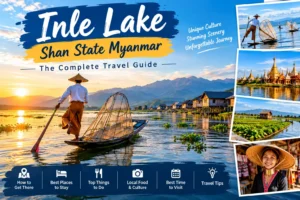
Inle Lake Shan State Myanmar, also spelled Inlay Lake, is located in southern Shan State, Myanmar, and is one of the country’s most iconic destinations. It is the second largest natural lake in Myanmar, situated in the middle of the Nyaungshwe Valley on the Shan Plateau, nestled between two mountain ranges that run from north to south, and it feels like a different world compared to the rest of the country.
The name Inle roughly translates to “big lake,” and it sits at an altitude of around 889 meters, covering an area of about 220 square kilometers, with a maximum depth of only around 6 meters. That shallowness is precisely what makes the lake so unusual — it allows floating gardens to be anchored to the lakebed, reeds to grow thick along the shorelines, and boats to glide through narrow water-lily channels that feel more like canals than open water.
Inle Lake was even selected by Condé Nast Traveler as one of the five new destinations in Asia that every traveler should explore. Surrounded by the Shan Hills on almost every side, it has a microclimate distinct from the hot, dusty plains around Bagan and Mandalay — mornings can be misty and cool, days pleasantly warm, and evenings genuinely chilly.
2. A Brief History of Inle Lake and the Shan People
Long before it became a fixture on Southeast Asia itineraries, Inle Lake was — and still is — home to the Intha people, an ethnic group whose name translates loosely to “sons of the lake.” For centuries, the Intha have built their entire way of life around the water: homes on stilts, gardens that float, markets that move from village to village, and a form of boat-rowing found almost nowhere else on Earth.
South of the lake lie the remains of the ancient city of Indein, with structures built from brick dating back to the 11th century — once the capital during the reign of a Shan king. This history matters because it places Inle Lake not just as a scenic curiosity but as the historical and cultural heart of Shan State, a region with its own language, cuisine, and identity distinct from the Bamar-majority lowlands of Myanmar.
Shan State itself is Myanmar’s largest state by area, bordering China, Laos, and Thailand, and it has historically been a mosaic of ethnic groups — Shan, Intha, Pa-O, Danu, and others — each with distinct dress, dialects, and traditions that visitors can still see reflected in the markets and festivals around the lake today.
3. Best Time to Visit Inle Lake
Because of its elevation, Inle Lake has a noticeably cooler climate than lowland Myanmar, and the season you choose will shape your entire experience.
The cool and dry season, from November to February, is peak time at Inle Lake, with pleasant daytime temperatures often between 20–28°C (68–82°F), cooler nights, clear skies, and misty mornings that are ideal for boat trips and outdoor activities — though November tends to be busy with visitors.
Here’s a quick breakdown of the three seasons:
- November–February (cool, dry season): The most popular time to visit. Crisp mornings, clear light for photography, and comfortable daytime temperatures. Expect more visitors and higher prices for boats and guesthouses.
- March–May (hot season): Temperatures climb noticeably, even at altitude. Mornings are still pleasant, but midday heat can be intense. Fewer tourists, so it’s a good trade-off if you don’t mind the warmth.
- June–October (monsoon/wet season): The lake is lush and green, water levels rise, and the surrounding hills turn a vivid emerald. Rain tends to fall in short, heavy bursts rather than all day, and this is also when the lake’s water level is at its fullest, which locals actually prefer for boat travel. It’s the quietest and cheapest time to visit, though some floating garden paths may be harder to reach.
The annual Phaung Daw Oo Festival in October is a particular highlight, filled with traditional boat races and a procession of golden Buddha images carried across the lake on an ornate barge — one of the most important religious festivals in all of Myanmar, and worth timing a visit around if your schedule allows.
4. How to Get to Inle Lake
Most travelers reach Inle Lake via the town of Heho, which has the nearest airport, followed by an hour-long drive down into the Nyaungshwe Valley. From there, the lake itself is only accessible by boat, so your journey typically ends at a jetty in Nyaungshwe town, where long-tail motorboats wait to take you out onto the water.
Common routes include:
- Flight to Heho, then road transfer to Nyaungshwe — the fastest option, especially when combining Inle Lake with Bagan, Mandalay, or Yangon in a single trip.
- Overnight bus from Yangon or Mandalay — a budget-friendly option, though the journey can take 10–12 hours depending on road conditions.
- Road from Kalaw — increasingly popular with travelers who arrive via the well-known Kalaw-to-Inle trekking route, a two- to three-day hike through Shan villages, tea plantations, and rice paddies that ends with a boat ride across the lake itself.
Given the current security situation across much of the country (covered in detail in Section 11), it’s essential to check the latest guidance before finalizing any overland route, as accessible roads and regions can change.
5. Top Things to Do at Inle Lake
A trip to Inle Lake is built almost entirely around the boat. Renting a private long-tail boat with a local driver for a half-day or full-day is the standard way to explore, and it opens up a circuit of villages, temples, markets, and workshops that would otherwise be impossible to reach.
Take a Full-Day Boat Tour
A standard boat tour typically includes stops at artisanal workshops, such as silversmiths demonstrating intricate Shan silver-working techniques, alongside stops to see local fishermen at work. Most boats depart early in the morning, when the water is calm and the light is soft, and return by late afternoon.
Visit Phaung Daw Oo Pagoda
Inle Lake is home to many religious sites, and the most famous is Phaung Daw Oo Pagoda, which holds sacred Buddha images that draw pilgrims from across the country to pray. During the annual festival, these gilded images are paraded around the lake’s villages on a spectacular barge shaped like a mythical bird, escorted by dozens of boats.
See the Jumping Cat Monastery
Nga Hpe Kyaung, often nicknamed the “Jumping Cat Monastery,” and Phaung Daw Oo Pagoda are both easily reached by boat and are commonly paired together on a single outing. The wooden monastery itself, built on stilts with Shan-style teak columns, is worth visiting for its architecture alone.
Explore the Ancient Stupas of Indein
One of the most rewarding side trips is the boat journey up a narrow canal to the village of Indein, where visitors find over 1,000 crumbling 17th-century pagodas hidden among the jungle, giving it the feel of a miniature, more overgrown version of Bagan. Some sources note the site holds around 2,478 stupas in total, and reaching it requires hiring a private driver since public transport doesn’t serve the area, but travelers consistently describe it as a highlight of their Myanmar trip.
Day Trip to Kakku Pagodas
Further afield (and subject to current access restrictions — see Section 11), the Kakku pagoda complex in Pa-O territory is another astonishing field of stupas, often visited with a licensed local guide as required by regional authorities.
Wander the Rotating Five-Day Market
The Ywama floating market, which meets once every five days, offers visitors a chance to shop and experience the indigenous culture of the local communities firsthand. Because it rotates between villages on a five-day cycle, it’s worth asking your guide or hotel exactly where the market will be held on the day you plan to visit.
Walk the Wooden Bridges of Nyaungshwe
Inle is defined by simplicity — wooden bridges that locals walk across every day, weaving workshops where everything is handmade, and a tranquility that’s sorely lacking in big cities. Spending an afternoon simply wandering Nyaungshwe on foot, without an itinerary, is one of the most underrated ways to experience the area.
Watch the Sunset From the Water
In the evening, the sun sets in a haze, the water turns golden, and an absolute silence descends — sitting on a platform by the water at that hour is, for many travelers, what makes the whole journey worthwhile.
6. The Intha People and the Art of Leg-Rowing
No description of Inle Lake is complete without its most famous image: fishermen balancing on the stern of narrow wooden boats, one leg wrapped around a long oar, rowing in a fluid, almost dance-like motion.
The Intha people are famous for this unique style of rowing, which lets them stand and see above the reeds and water lilies as they navigate the shallow lake — a technique born from necessity. The style lets them see over the water plants while rowing, helps with both fishing and travel, and the Intha people take real pride in this part of their culture.
Most boat tours in 2026 include a stop to watch these skilled fishermen at work, casting their distinctive conical nets into the shallows. It’s worth noting that leg-rowing is a practical fishing technique, not a staged tourist performance — though a small number of rowers near popular routes do pose for photos in exchange for tips, and it’s worth distinguishing between the two if authenticity matters to your trip.
7. Floating Gardens and Local Crafts
Perhaps the single most ingenious feature of Inle Lake is its agriculture. Farmers create floating “islands” from weeds and silt, anchored to the lakebed with bamboo poles, and use them to grow tomatoes, cucumbers, and flowers — with the boat ride through these green garden alleys ranking among the highlights of any Inle trip.
These gardens supply a huge share of Myanmar’s tomato crop, and rows of them stretch for kilometers across parts of the lake, forming narrow green corridors just wide enough for a single long-tail boat to pass through.
Beyond farming, the villages around Inle Lake are also home to a concentration of traditional craft workshops, including:
- Silversmiths, hand-forging jewelry using techniques passed down through generations of Shan artisans.
- Weavers, producing textiles from cotton, silk, and — uniquely to this region — lotus fiber, harvested by hand from the stems of lotus plants growing in the lake.
- Cigar rollers, hand-rolling traditional cheroot cigars flavored with local herbs and tobacco.
- Boat builders and blacksmiths, whose workshops are often included on standard boat-tour circuits.
Buying directly from these workshops is one of the most meaningful ways to support the local economy, since much of it depends on tourism income that has fluctuated sharply in recent years.
8. Villages and Temples Around the Lake
The lake’s surrounding shoreline and canals are dotted with distinct villages, each with its own specialty:
- Nyaungshwe — the main gateway town on land, with the widest range of guesthouses, restaurants, and bike rental shops.
- Ywama — home to the rotating floating market and several weaving workshops.
- Indein — the site of the sprawling, overgrown pagoda complex described above.
- Maing Thauk — known for its long wooden bridge connecting a hillside village to the water.
- In Dein and In Paw Khon — centers of lotus-silk and cotton weaving.
Inle Lake is often paired with Bagan or Kalaw in a broader Myanmar itinerary, since combining the lake with those destinations creates a classic 7–10 day trip, or one can add Kalaw specifically for hiking.
9. Food and Dining at Inle Lake
Shan cuisine has its own identity within Myanmar’s broader food culture, shaped by the region’s cooler climate, hill-grown produce, and cross-border influences from Yunnan and northern Thailand.
While visiting, it’s worth trying Shan noodles, tomato salad, and fresh lake fish, and vegetarian options are widely available, with Nyaungshwe offering good cafes and markets. A few dishes and ingredients worth seeking out specifically:
- Shan noodles (khao soi-adjacent, but distinct) — rice noodles served in a light, slightly tangy broth or tossed dry with pickled vegetables, peanuts, and chili oil.
- Tomato salad — made with the lake’s own floating-garden tomatoes, tossed with herbs, crushed peanuts, and lime.
- Lake fish — usually grilled or steamed, given the lake’s role as a major local fishery.
- Shan tofu — made from chickpea flour rather than soybeans, served both as a soft curry-like dish and as crispy fried strips.
- Local Shan tea and coffee, grown in the surrounding hills and widely available in Nyaungshwe’s cafes.
Some travelers also recommend seeking out French-Shan fusion restaurants overlooking the canals for an evening meal with a view.
10. Where to Stay: Nyaungshwe vs. Over-Water Resorts
Accommodation around Inle Lake generally falls into two categories, and the choice shapes the whole feel of your stay.
Nyaungshwe is the main town on land, with more food options, bars, and budget-friendly guesthouses, making it the practical choice for travelers who want convenience and a social atmosphere. Staying here also makes it easy to rent a bicycle and explore the surrounding countryside independently, or to walk to restaurants and markets in the evening.
Over-water resorts, by contrast, are located directly on the lake itself — more expensive and quieter, but waking up to the sound of the water and the sunrise over the lake is genuinely an unforgettable experience. These properties range from mid-range stilt-house lodges to high-end resorts with private jetties, and they’re best suited to travelers prioritizing atmosphere and tranquility over nightlife or budget.
11. Is It Safe to Travel to Inle Lake in 2026?
This is the section that matters most, and it deserves a direct, honest answer rather than a glossed-over one.
Myanmar’s political and security situation has remained volatile since the 2021 military coup, and conditions vary enormously by region. Following the elections held by the military in December 2025 and January 2026, the security situation in Myanmar remains extremely tense; although the elections proceeded largely peacefully in the major cities, a lasting resolution to the country’s long-running conflicts is not expected, since pro-democracy and ethnic opposition groups were excluded from the vote, and opposition forces are estimated to still control roughly 40 percent of the country.
Official government advisories remain considerably more cautious than independent traveler accounts. The UK’s Foreign, Commonwealth & Development Office, for instance, advises against all but essential travel to Shan State South and East — the area that includes Inle Lake — as well as to Mandalay Region and central Rakhine State, while advising against all travel to a longer list of other states and regions entirely.
Given this, anyone planning a trip should:
- Check official government travel advisories immediately before booking and again immediately before departure — from your own country’s foreign ministry, not solely from travel blogs.
- Work with an established, licensed local tour operator who has current, on-the-ground knowledge of which routes and areas are accessible.
- Register your trip with your embassy where that service is available.
- Avoid all border regions, northern Shan State, and any area outside the well-established tourist circuit, regardless of how the itinerary looks on a map.
- Stay flexible — flights, roads, and permitted zones in Myanmar can change with little notice, and a trip plan that was valid a few months ago may not be valid today.
12. Responsible and Sustainable Travel Tips
Inle Lake’s ecosystem is fragile, and tourism — while economically vital to local communities — has also placed real strain on the lake’s water quality, floating garden systems, and wildlife. A few ways to travel more responsibly:
- Choose boat operators and guesthouses that are locally owned, so tourism income stays within the communities that depend on it.
- Avoid single-use plastic where possible; bring a refillable water bottle and a filter or purification tablets rather than buying bottled water on every leg of the trip.
- Don’t pressure leg-rowers into staged photo stops unless they’ve clearly set up to offer that — it can disrupt actual fishing activity and creates an uncomfortable dynamic.
- Dress modestly at religious sites, covering shoulders and knees, and remove shoes before entering pagodas and monasteries.
- Buy crafts directly from workshops rather than resellers, so silversmiths, weavers, and cigar-rollers see a fairer share of what you spend.
- Ask before photographing individuals, particularly in smaller villages away from the main tourist circuit.
13. Sample 3-Day Inle Lake Itinerary
Day 1: Arrival and Nyaungshwe Arrive via Heho airport, transfer to Nyaungshwe, and spend the afternoon settling in — rent a bicycle, wander the wooden bridges, and have dinner at a local Shan restaurant.
Day 2: Full-Day Lake Boat Tour Depart early by long-tail boat. Visit Phaung Daw Oo Pagoda, the Jumping Cat Monastery, a silversmith workshop, a lotus-weaving village, and the floating gardens. Time your route to catch the rotating five-day market if it aligns with your visit. Return for sunset on the water.
Day 3: Indein Pagodas and Departure Take the canal boat ride up to Indein to explore the hillside field of ancient stupas in the morning light, before the day-trippers arrive. Return to Nyaungshwe for a late lunch, then transfer back to Heho for departure — or continue overland toward Kalaw or Mandalay if your itinerary allows.
Travelers with more time often extend this to 4–5 days to add the Kakku pagodas, a portion of the Kalaw-to-Inle trek, or simply a slower pace with more unstructured time on the water.
14. Packing Tips for Inle Lake
Because of the altitude — around 900 meters above sea level — mornings and evenings on the lake can be surprisingly cold even when the days are sunny, so it’s worth bringing a sweater regardless of the season. Beyond that:
- Layers for cool mornings and evenings, even in the hot season.
- A light rain jacket if visiting between June and October.
- Comfortable, closed walking shoes for village visits and light trekking.
- Modest clothing — shoulders and knees covered — for temple and monastery visits.
- A hat, sunscreen, and insect repellent.
- A dry bag or waterproof phone pouch for open-boat rides, where spray is common.
- Cash in small denominations — many village shops and smaller guesthouses don’t accept cards.
15. Frequently Asked Questions
How many days do you need at Inle Lake? Two to three full days is enough to see the highlights — the main boat circuit, Indein, and Nyaungshwe town — while four to five days allows for a slower pace, a side trip to Kakku, or a portion of the Kalaw trek.
Can you swim in Inle Lake? It’s uncommon and not generally recommended, both due to water quality concerns near populated stilt-village areas and out of respect for the lake as a working ecosystem and water source for local communities.
Is Inle Lake worth visiting if I’m short on time in Myanmar? For most travelers, yes — it offers a completely different experience from temple-focused destinations like Bagan, centered instead on daily village life, craft, and a distinctive landscape found almost nowhere else in the world.
What currency is used at Inle Lake? The Myanmar kyat (MMK) is the local currency. US dollars are sometimes accepted at hotels and larger businesses, but small, crisp, undamaged notes are essential if carrying dollars, since worn or marked bills are frequently refused.
Do I need a guide to visit Inle Lake? A guide isn’t strictly required for the main boat circuit, but a knowledgeable local boat driver or guide adds significant context to the villages, crafts, and religious sites — and, given the current security situation, working with an established local operator is strongly advisable regardless.
16. Final Thoughts
Inle Lake Shan State Myanmar, is not a destination you rush through. Its appeal isn’t a single monument or a postcard viewpoint — it’s the accumulation of small, quiet moments: a leg-rower gliding past a floating tomato garden at dawn, a silversmith bent over his workbench in a stilt-house workshop, the golden hush that settles over the water at sunset. Inle is memorable not for the pictures, but for the feeling it leaves behind.
At the same time, a trip here in 2026 requires more preparation and awareness than it once did. Myanmar’s broader security situation is genuinely serious, and no travel guide — including this one — should be treated as a substitute for current official advisories and an experienced local operator. For those who do their homework, travel responsibly, and go in with realistic expectations, Inle Lake in Shan State, Myanmar, remains one of Southeast Asia’s most rewarding and least crowded highland destinations — a place where an entire community has built its life on water, and welcomes visitors, carefully, into that world.
Pingback: Solo Trip in Bangalore: The Complete 2026 Travel Guide